How humanity discovered the brain
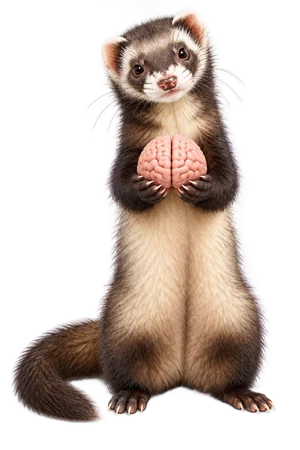
Today it seems obvious that we think with our brains. That idea is not as old, or as simple, as it sounds - it took humanity about two and a half thousand years and dozens of wrong theories to get there. This is the story of how the mind stopped being a mystery for philosophers and became something we could study and test
When the ancient Egyptians mummified their pharaohs, they carefully preserved the heart, liver, and stomach - but pulled the brain out through the nose with a hook and threw it away. The process was called excerebration: embalmers pushed an iron hook through the nostril, broke through the thin bone at the base of the skull, and worked the brain tissue loose until it could be removed. They believed the brain was good for nothing but producing mucus, while the heart held consciousness, intelligence, memory, and the soul. The brain simply had no reason to make the trip to the afterlife
The first to strongly disagree was Hippocrates - yes, the same Hippocrates whose oath doctors still take today. In his work On the Sacred Disease, written around 400 BC, he stated plainly that our pleasures, joys, laughter, sadness, pain, and tears all come from the brain, and that the brain was the organ responsible for thinking and perception. The idea seems obvious now, but it was close to revolutionary at the time. The problem was that Hippocrates had no way to prove it
About a century later, one of the greatest authorities of the ancient world turned the argument the other way. Aristotle believed the heart was the seat of intelligence, and given the anatomy he'd studied, his reasoning made sense for the time: the brain was cold, nearly bloodless, and did not react when touched, while the heart was warm, constantly beating, and reacted instantly to emotion. In On the Parts of Animals, he argued that the heart was the center of reason and that the brain's real job was simply to cool the blood as it rose from the heart
Aristotle was an incredible observer in many other areas, but by turning the brain into a kind of biological radiator, he left science stuck for centuries. His authority was so great that very few people were willing to challenge him
Blood, quite literally, helped settle the argument. In the second century AD the Roman doctor Galen treated wounded gladiators and watched closely what happened when different parts of the body were injured. He noticed something simple: a blow to the head could take away a person's speech, movement, or consciousness, while a blow to the chest - even one that injured the heart - did not
Galen went further than observation and began dissecting animals, since Roman law forbade dissecting humans. In a way, this was the start of an experimental approach to the brain: instead of just reasoning about how it worked, test it and see what happens
In front of amazed audiences, he cut and blocked different nerves in pigs and goats. His most famous experiment shocked onlookers: when he cut the recurrent laryngeal nerve of a squealing pig, the animal instantly stopped making any sound, even though it could still move freely. Galen had shown that the brain controls the body, and the voice, through the nervous system
Galen still believed the heart was the body's main center, where blood was filled with vital energy - but he had stripped it of its status as the center of thought. His authority in anatomy grew so strong that his ideas about the brain stood largely unchallenged for almost 1,500 years, until the Renaissance
After Galen, science went quiet for a long time. Medieval scholars mostly repeated his ideas instead of testing them, and tried to fit anatomy into religious teaching. This led to the so-called ventricular theory: the soul, it was thought, could not live inside solid brain tissue, so it must live instead in the empty spaces inside it - the ventricles
For centuries, medieval drawings showed the brain as three neat little chambers, each one supposedly storing a different faculty: imagination, reason, and memory. It looked tidy and logical, but it owed more to artists and theologians than to actual dissection. The stagnation lasted until the Renaissance, when researchers finally picked their scalpels back up
A real shift came in the 17th century with René Descartes, who introduced an idea that would shape scientific thinking for centuries: the body was a machine, like a clock or a hydraulic system, running on the laws of physics
Descartes imagined nerves as little tubes filled with "animal spirits," a kind of fine fluid that moved the muscles
But this created a problem for the mind. Descartes believed thinking, consciousness, and the soul were entirely separate from the physical body, which raised an uncomfortable question: if the body is a machine and the mind is something non-physical, how do the two actually talk to each other?
Descartes proposed the pineal gland, a small structure at the center of the brain, as the meeting point - but he never quite explained how the meeting worked. The gap between the "mechanical body" and the "non-physical mind" became known in philosophy as the mind-body problem, and in some ways we're still arguing about it today
But the idea that the body was a machine had a huge practical consequence. If the body followed the laws of physics, then we could study it like any other machine: by cutting it open, measuring things, and running experiments
This finally broke down the barrier that had stopped researchers from studying the human body in a purely scientific way
By the end of the 18th century, scientists discovered something unexpected: nerves did not work through mysterious "spirits." They worked with electricity
Italian doctor Luigi Galvani noticed that a frog's severed leg would twitch when touched with metal during a storm, or even when two different metals were connected. He believed he had discovered "animal electricity," a special life force
Galvani's rival, physicist Alessandro Volta, showed that the effect was not some mysterious animal power - it was ordinary electrical current produced when two different metals interacted. Volta eventually invented the world's first battery
Interestingly, both men were partly right. There really is electricity in our nerves - it's just not mysterious. It can be measured, and German physiologist Emil du Bois-Reymond confirmed exactly that in the 1840s, using precise instruments to record nerve impulses as electrical signals
The brain was no longer an impossible, almost magical thing. It had become an electrical system: incredibly complicated, but something we could actually measure
The next major breakthrough came from a hospital room. In 1861, French doctor Paul Broca treated a patient known as "Tan" - after a stroke, that single syllable was all he could say, though he understood everything perfectly
When the patient died, Broca examined his brain and found clear damage in one specific area of the left hemisphere
This was a powerful piece of evidence. It was not an abstract theory anymore. One area was damaged, and one specific ability was lost
Thirteen years later, German neurologist Carl Wernicke discovered another area involved in understanding speech. His patients could speak fluently, but what they said made no sense, and they could not understand what other people were saying
This led to the idea of functional localization: different abilities do not simply live somewhere in "the brain." They are connected to specific, relatively small areas
This was an important addition to what Galen had discovered. Yes, the brain controls the body, but it does not work as one giant, undivided mass. It works more like a team of specialists, each with its own job
One major question was still unanswered: what exactly is nervous tissue made of?
By the end of the 19th century, most scientists believed in what was called the reticular theory: the brain was one continuous network, something like a giant web where everything was connected to everything else
Spanish anatomist Santiago Ramón y Cajal proposed a revolutionary alternative: the brain was made up of billions of separate cells
Ironically, the evidence came from a technique invented by his biggest scientific rival, Italian scientist Camillo Golgi. Golgi had developed a silver staining method that colored only a handful of cells out of hundreds, which made the shape of individual cells clearly visible under a microscope
Cajal spent countless nights looking through a microscope and carefully drawing what he saw. He showed that brain cells, or neurons, touch each other but do not actually merge together
In 1906, Cajal and Golgi shared the Nobel Prize. But even during the award ceremony, Golgi gave a lecture defending his incorrect theory that the brain was one continuous network
Time proved Cajal right. Today, his neuron doctrine is taught in biology classes around the world
By the end of the 19th century, the big picture was finally coming together. The brain was a hugely complex electrical machine made up of billions of individual cells, with different areas responsible for different functions
It was a triumph for anatomy. But one huge question remained, and neither a scalpel nor a microscope could answer it
How do thoughts, hidden desires, and everyday habits come from this mass of tissue and electrical signals?
Scientists could dissect the brain forever, but the answer was deeper. It was not just in the structure of the organ. It was in the behavior of a living creature
Ivan Pavlov was not planning to study the brain or the mind. He was a physiologist deeply interested in digestion, and he studied dogs by carefully measuring how much saliva, stomach juice, and other digestive fluids they produced in response to different foods
His work was so thorough that he won the 1904 Nobel Prize in Physiology or Medicine for it - and this was before his famous work on conditioned reflexes. The prize was for his research into the digestive system alone
But during this careful research, Pavlov noticed something that was getting in the way of his measurements. The dogs started producing saliva before they even received their food. They would start salivating simply when they heard the footsteps of the lab assistant who usually fed them
From the point of view of a clean digestion experiment, this was an annoying problem. But instead of ignoring this "noise" in his data, Pavlov asked himself a different question: what if this was not a problem, but the most interesting part?
He designed a simple experiment. Before feeding the dogs, he repeatedly rang a bell. After a while, the dogs started salivating just from hearing the bell, even when there was no food
The dogs had learned to connect a neutral sound with something important: food
Pavlov called this a conditioned reflex, as opposed to an unconditioned reflex, such as salivating when food is placed in front of you
This simple experiment turned out to be hugely important
For the first time, a scientist had taken something that seemed purely mental and difficult to measure - learning, association, expectation - and turned it into a strict, measurable, repeatable scientific experiment
There was no need to ask the dog what it was feeling. Scientists could simply measure the amount of saliva in milliliters
The mind, which had been treated as a subject for philosophy for centuries, could now be studied using the same kind of experimental science already being used to study digestion and electrical activity in nerves
The discovery went far beyond the study of dogs. It became one of the foundations of behaviorism, a school of psychology later developed in the West by John Watson and B. F. Skinner
They suggested that by studying simple, measurable connections between stimuli and responses, scientists could begin to explain much more complicated human behavior
Pavlov himself was actually skeptical of psychology as a science. Throughout his life, he insisted that he was a physiologist, not a psychologist
But his strict laboratory approach showed psychologists something extremely important: the mind could be studied scientifically, not just discussed through philosophical theories
Here's the whole journey in a few lines:
Finally, Ivan Pavlov took perhaps the boldest step of all - he showed that even things that had seemed impossible to measure for centuries, like learning, expectation, and habit, could be captured in a strict scientific experiment
By the beginning of the 20th century, the brain had stopped being a mysterious puzzle for philosophers. It had become a proper subject of science, with detailed maps, organized cells, electrical signals, and measurable laws of behavior
Today we no longer have to argue about where thoughts come from, or guess how memory works. Science has given us maps and rules for understanding the brain, and modern tools let us actually put that knowledge to use. QuintaCapsa turns one small piece of it - spaced repetition - into a simple, effective habit for remembering the things you choose to learn
Start learning with QuintaCapsa →
See you in the next one